
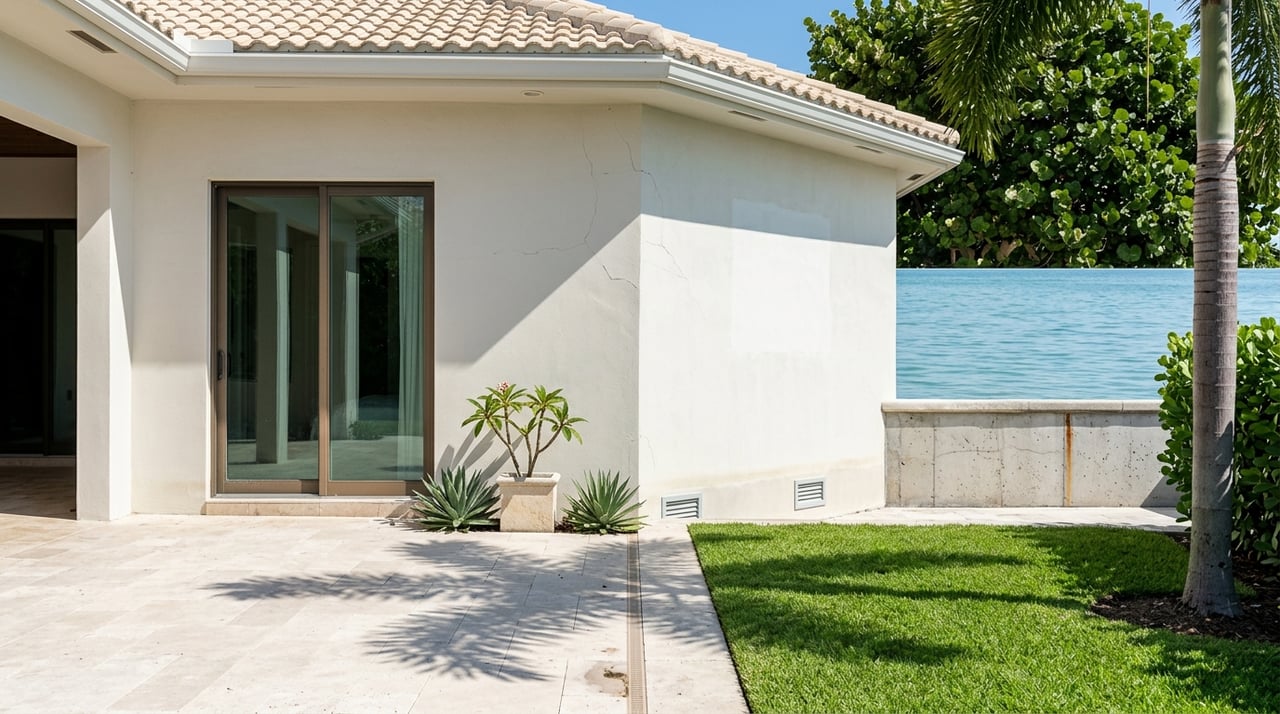
Should You Renovate or Rebuild a Waterfront Home?
Trying to decide whether an older waterfront home in North Palm Beach is worth renovating or better suited for a fresh start? It is a common question, especially when a property offers an exceptional lot, private water access, or long-term family value, but the house itself shows its age. If you are weighing a purchase or planning the next chapter for a legacy property, understanding structure, flood rules, and land value can help you make a smarter decision before costs escalate. Let’s dive in.
When you evaluate an older waterfront home, it helps to separate the decision into three parts: the condition of the structure, the likelihood of flood-related compliance work, and the value of the land itself. On coastal properties, those three variables often matter more than finishes or floor plan alone.
FEMA notes that coastal moisture and salt spray can speed up corrosion and decay in buildings, which is why waterfront homes deserve a closer look at structural durability and exposed materials. At the same time, Palm Beach County property records can help you compare land value to improvement value, which gives you an early clue about whether you are buying a house, a homesite, or some combination of both.
In practical terms, renovation often makes more sense when the shell is fundamentally sound and your project can stay below major compliance triggers. Rebuilding tends to become more attractive when the lot is highly valuable, the house needs major remediation, or the planned work may lead to expensive flood-related upgrades anyway.
Older waterfront homes can hide issues that are less common inland. Corrosion is one of the biggest concerns, especially on exposed metal components such as connectors, fasteners, railings, and exterior hardware.
According to FEMA coastal construction guidance, salt spray and moisture can accelerate corrosion and decay, which makes the condition of the existing shell especially important in a waterfront renovation decision. If the structural framework is compromised, even a well-intended remodel can quickly become a much larger project.
You should also pay attention to signs of repeated water intrusion, chronic drainage issues, and site movement. The Village of North Palm Beach flood guidance encourages owners to ask whether a property is in a high-risk flood zone, has flooded repeatedly, is susceptible to coastal erosion, or already has an elevation certificate on file.
A few warning signs deserve immediate attention when you tour or evaluate an older waterfront property:
None of these automatically means you should walk away. They do mean you should evaluate the property with clear eyes and a realistic budget.
Floodplain rules can dramatically change the cost equation. In Palm Beach County, no construction in a floodplain, including earth-moving, is legal without a permit, and the county uses the same general substantial-improvement framework that many waterfront owners encounter during major remodels.
The official source for flood maps is the FEMA Flood Map Service Center. If your planned work is treated as a substantial improvement, local rules may require the home to be brought into compliance with flood-resistant construction standards.
For many older homes, that can mean elevating the lowest floor and potentially lifting important equipment such as air conditioning systems or generators to or above base flood elevation. The Town of Palm Beach substantial improvement notice makes those consequences especially clear.
Palm Beach floodplain rules define substantial improvement as work that equals or exceeds 50% of the building’s market value, excluding land value. That distinction matters because a renovation budget that seems reasonable at first can trigger a much more expensive compliance path once the scope and valuation are fully reviewed.
This is one reason buyers and legacy owners should not evaluate waterfront renovations only by comparing cosmetic upgrade costs. A project that starts as a remodel can quickly become a flood-compliance and elevation project if the numbers cross the threshold.
Permitting is another area where older waterfront homes can surprise you. In North Palm Beach, permits are submitted online, contractors must be registered before permit submittal, and projects over $5,000 generally require a recorded Notice of Commencement, according to the Village of North Palm Beach Building Division.
The village also states that new structures, additions, and substantial renovations affecting properties in Flood Zones A, AE, V, or VE require detailed flood documentation. Depending on the parcel, that may include flood hazard boundaries, base flood elevation information, site grading, and in some cases coastal construction control line documentation.
If the property is seaward of the coastal construction control line, state review may also come into play. The Florida Department of Environmental Protection CCCL program outlines separate permitting guidance for construction in those regulated coastal areas.
If you are leaning toward a teardown, the process may involve more than hiring a demolition contractor. North Palm Beach notes that complete demolition permits require existing-use credit with Palm Beach County Impact and the Florida DEP, and nearby municipalities show how involved demolition documentation can become.
For example, nearby permit checklists in Boca Raton and Delray Beach include items such as utility disconnect letters, surveys, cost breakdowns, elevation certificates, and Notices of Commencement. Even though each municipality has its own process, the broader lesson is clear: demolition and rebuild projects on coastal properties often require more coordination than owners expect.
Renovation budgets can grow quickly, even before waterfront-specific issues are added in. The 2025 Cost vs. Value report lists national average benchmarks such as $82,793 for a midrange major kitchen remodel, $26,138 for a midrange bath remodel, $22,073 for vinyl window replacement, and $51,865 for a metal roof replacement.
Those are not Palm Beach-specific bids, but they are a useful reminder that renovating older homes is rarely cheap. Once you add structural repairs, corrosion remediation, or systems upgrades, the numbers can move fast.
National benchmark data for teardown projects also shows a wide cost range. HomeAdvisor’s demolition cost guide puts whole-house demolition at an average of $15,800, with a common range of $6,000 to $25,000, while its home-building guide notes custom homes often run about $200 to $550 per square foot.
On older waterfront properties in Palm Beach County, the real issue is usually not just one line item. It is the full stack of costs that can include demolition, flood compliance, elevation work, utility disconnects, site protection, permit documentation, and coordination around docks or boat lifts.
One of the simplest and most helpful screens is comparing the lot value to the value of the improvements. Because Palm Beach County’s Property Appraiser records separate land and improvement values, you can begin to see whether the market is placing most of the value in the homesite itself.
If the land value strongly outweighs the contribution of the structure, that can suggest the property is functioning more like a redevelopment opportunity. If the existing house still carries meaningful value and the shell is in good shape, renovation may deserve a closer look.
This is not a hard rule, but it is a useful starting point. On premium waterfront parcels, especially those with desirable water access or private dock potential, the land can become the dominant part of the equation.
Whether you are buying a waterfront home or deciding what to do with one you already own, a few questions can help clarify the path forward:
These are the kinds of questions that can save you from making a decision based only on square footage, finishes, or a quick contractor estimate.
Renovation is often the better path when the existing structure is fundamentally sound, the floor plan can be improved without major structural intervention, and the likely scope stays manageable from a flood-compliance standpoint. It can also make sense when you want to preserve a home with personal or family significance and the economics still support that choice.
For some waterfront owners, a thoughtful renovation can unlock substantial value without the complexity of a full teardown and rebuild. The key is making sure the project is evaluated through a coastal lens, not just a standard remodeling lens.
Rebuilding often deserves stronger consideration when the lot is exceptional, the existing house has extensive deterioration, or the cost to modernize the structure approaches the point where starting new is more efficient. This is especially true when a renovation may still force major compliance upgrades that narrow the cost gap between remodeling and rebuilding.
On high-value waterfront sites, buyers are often really paying for location, water frontage, and long-term utility of the parcel. In those cases, the existing house may be less of an asset and more of a temporary improvement on a valuable homesite.
If you are evaluating an older waterfront property in North Palm Beach or along the broader Palm Beach County coastal corridor, a careful review of structure, flood exposure, permitting, and land economics can make the decision much clearer. That kind of upfront analysis helps protect both your budget and your long-term plans. If you would like discreet guidance on a waterfront property, valuation strategy, or renovation-versus-rebuild analysis, connect with Reback Realty for a confidential conversation.
Stay up to date on the latest real estate trends.
We pride ourselves on informing and educating our clients in order to make better real estate decisions. Contact us today to find out how we can be of assistance to you!

Reback Realty
11420 US HIGHWAY 1 PMB 122 NORTH PALM BEACH FL 33408