
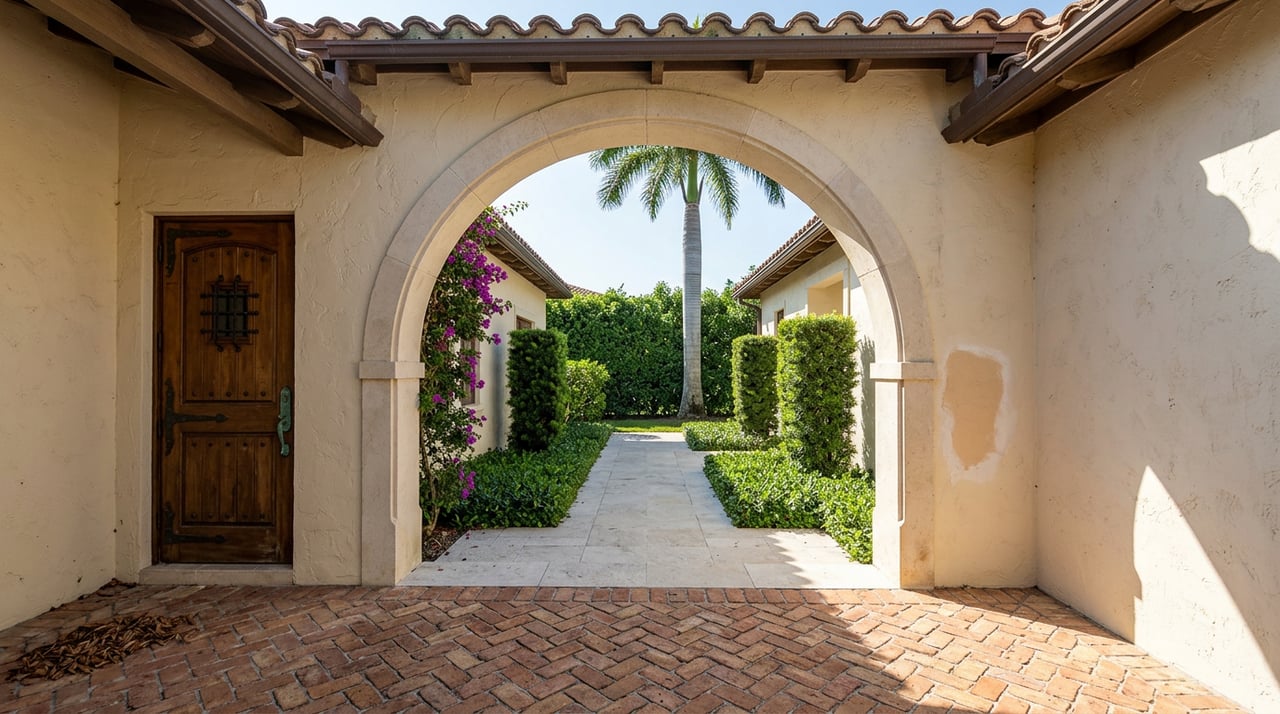
In Palm Beach, the House Most At Risk of a Landmark Surprise Doesn't Look Historic at All
The house at 141 Chilean Avenue has no famous architect attached to its plans. No documented architect at all, in fact. Town records list the builder as unknown, and the best guess from the consultants who studied it is that a contractor put it up himself sometime between 1910 and 1915. No one famous ever lived there. It is a wood-frame bungalow with Prairie-style touches, a wraparound porch that was later enclosed, and windows and roofing that have been replaced more than once over the past century.
In May 2026, the Town Council voted to make it a landmark anyway, over the objection of the corporation that has owned it for roughly three decades.
That case is worth sitting with before you write an offer on an older Palm Beach home you plan to renovate, because it overturns the assumption most buyers walk in with. The instinct is to treat landmark exposure like a disclosure item: check the town's list, confirm the house isn't on it, move forward. What the Chilean Avenue vote shows is that the list is not the risk. The process that adds to it is.
The Town of Palm Beach's Landmarks Preservation Commission designates properties using a defined set of criteria tied to historical significance and architectural distinction, not to market value or curb appeal. The Chilean Avenue bungalow qualified, in the commission's reading, under two of those criteria even though its own attorney argued the house didn't meet either one. The Landmarks Preservation Commission's own recommendation on the case was close, not unanimous. The Town Council disagreed with the owner's objection anyway. On the council floor, the split ran along familiar lines: council members Lew Crampton and Nicki McDonald argued the home wasn't a strong enough example of its style to warrant protection, while Bridget Moran, Ted Cooney, and Moore favored preserving it, with Moore telling the room she found the house "charming" and worth keeping, according to Palm Beach Daily News coverage of the meeting.
Under the town's ordinance, an owner's opposition does not stop a designation. Once the vote passes, any exterior change visible from the street, and in some cases interior features, requires Landmarks Preservation Commission approval going forward. That is true whether the owner asked for the distinction or fought it in front of the council with a lawyer.
The reason this case is more useful to a buyer than a bigger, flashier landmark fight is that it involves an unremarkable house. No oceanfront lot, no name-brand architect, no prior owner anyone would recognize. If a plain bungalow with a replaced roof and a century of ordinary maintenance can clear the bar, the honest read is that a lot of older, modest Palm Beach houses that look completely unremarkable today are candidates tomorrow, and the review doesn't wait for a sale to happen. It runs on the town's own calendar, triggered by staff research or a council referral, independent of whether the current or future owner has any renovation plans at all.
There is a narrow escape valve in Florida law. A 2022 state statute allows single-family owners who object to a landmark designation to demolish the home anyway if it sits in a flood-hazard area and fails FEMA flood-elevation standards. It is a real option for some waterfront parcels. It does almost nothing for the inland, older homes that tend to be exactly the type getting swept into designation in the first place, since those are frequently the properties furthest from the flood-hazard overlay to begin with.
Landmark designation is the sharpest version of this risk, but even a house that never comes close to landmark status still answers to the Town's Architectural Commission, known locally as ARCOM, for any new construction or substantial exterior alteration visible from a public right of way. As of 2026, roughly 80 significant single-family projects are moving through Palm Beach permitting at any given time, and fewer than half deliver on the timeline the owner originally set. The reason rarely traces back to the framing crew.
| Stage | What happens | Typical add |
|---|---|---|
| Pre-application and design | Architect develops the scheme before anything reaches the town | 4 to 8 weeks |
| First ARCOM hearing | Commission votes preliminary approval or remands for revisions | Each remand costs another 4 to 6 weeks |
| Final ARCOM approval | Quarter-scale elevations, material samples, window details reviewed a second or third time | Adds to the total before permit submission |
| Building Division permit review | Standard review for a new single-family | 12 to 20 weeks |
| Coastal Construction Control Line review | Runs in series with ARCOM on oceanfront parcels, not alongside it | Another 3 to 5 months |
| Construction | For a 6,000 to 10,000 square foot custom residence | 16 to 22 months |
A recent ARCOM agenda gives a sense of how much volume moves through this pipeline at once. New single-family applications for addresses including 230 Plantation Road and 418 Seaspray Avenue sat alongside a full renovation and landscape redesign at 1066 North Ocean Boulevard. Even a storefront at 259 Worth Avenue seeking approval for new signage, an entry door, and awnings needed a full hearing, and was deferred to the commission's June 24, 2026 meeting. On this island, an awning gets the same procedural seriousness as a roofline.
None of this is a trap for first-time buyers alone. Developer Todd Michael Glaser, who paid $85 million for Tarpon Island and $18.5 million for the El Brillo Way estate once owned by Jeffrey Epstein before demolishing it, has said publicly that the ARCOM process can be disheartening even for someone with his track record, including a preservation award from the town's own Preservation Foundation for a separate restoration project. Scale and experience shorten the learning curve. They don't exempt anyone from the calendar.
A few questions are worth asking before, not after, a contract is signed on an older Palm Beach home:
Can I close on a Palm Beach estate before ARCOM approves my renovation plans? Yes, and most buyers do. The tradeoff is that the review clock starts at closing, and any carrying costs incurred during design and hearings become the buyer's expense rather than something negotiated into the purchase price.
Does landmark status hurt resale value? It depends on the buyer. Some see the designation as a guarantee that a neighbor can't tear down an adjacent property for a mismatched design, and value the prestige. Others treat the restriction on future materials and modifications as a real constraint. Either way, it belongs in the underwriting before an offer, not in a surprise after one.
How do I know if my property could become a landmark candidate later, even if it isn't one now? Age and documentation gaps matter more than architectural pedigree. A house doesn't need a famous name attached to qualify. A conversation with someone who tracks Landmarks Preservation Commission and Town Council agendas regularly is a more reliable read than a one-time database check.
Palm Beach's review boards protect something real about the island, and that protection is part of what keeps its streets looking the way they do a century after most of these houses were built. It also means the due diligence on an older home here has to go further than confirming today's status. Reback Realty has spent decades working these blocks and pairs that local history with David Reback's background as a licensed contractor, so buyers get a straight read on what a property can become, not just what it is on the day you see it. If you're weighing a purchase with renovation in mind, request a confidential home valuation before you write the offer, not after.
Stay up to date on the latest real estate trends.
We pride ourselves on informing and educating our clients in order to make better real estate decisions. Contact us today to find out how we can be of assistance to you!
Reback Realty
11420 US HIGHWAY 1 PMB 122 NORTH PALM BEACH FL 33408